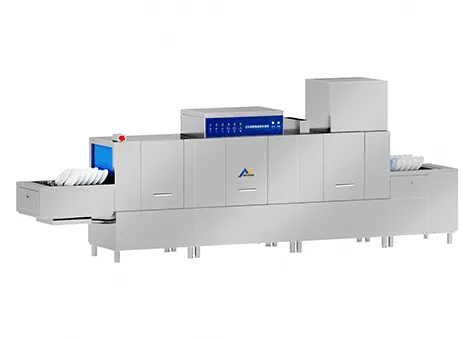
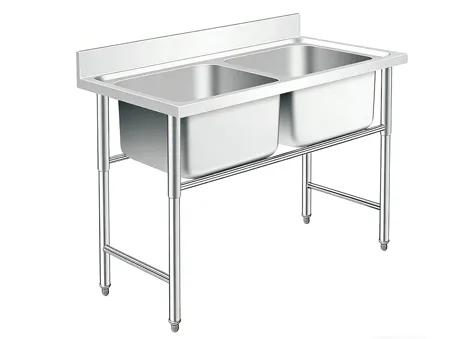
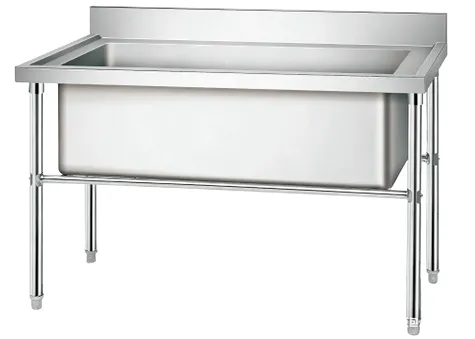
For most commercial kitchens, 60 racks per hour is a practical starting point for a hood type dishwasher, but the right capacity depends on your busiest dish-return period, rack loading pattern, available labor, and required washing cycle. High-volume operations may need 70–80 racks per hour, while a lower-throughput kitchen can operate efficiently with a 40–60 rack/hour machine.
The important point is that a machine's rated capacity is not the same as the number of racks your dishwashing area will actually process every hour. A commercial hood type dishwasher should be sized around peak real-world demand, with enough reserve capacity to prevent dirty dishes from accumulating during service.
Manufacturers commonly publish capacities around 60 racks/hour for standard hood-type models, while higher-performance machines can reach 70–80 racks/hour under specified operating conditions. For example, HOBART lists 60 racks/hour for its H604 and up to 70 racks/hour for its PREMAX AUPL, while Electrolux Professional lists models capable of up to 80 racks/hour in high-productivity mode.
What Does Racks per Hour Actually Measure?
"Racks per hour" describes the theoretical throughput of a dishwasher based primarily on its programmed cycle time and operating conditions.
A standard commercial rack is commonly around 500 × 500 mm, although rack dimensions and usable chamber space vary between machines. A hood type dishwasher processes one rack at a time, with the operator loading the rack, starting or closing the hood, completing the wash and final rinse, and then transferring the clean rack to the clean side.
The basic theoretical relationship is:
Racks per hour = 3,600 ÷ cycle time in seconds
For example:
60-second cycle = up to 60 racks/hour
90-second cycle = up to 40 racks/hour
120-second cycle = up to 30 racks/hour
180-second cycle = up to 20 racks/hour
However, this calculation represents machine cycle time, not necessarily the actual throughput of the dishwashing station.
Commercial equipment specifications demonstrate why capacity figures must be interpreted carefully. One HOBART hood type model, for example, is rated at up to 60 racks/hour with selectable 60-, 120-, and 180-second cycles. Another Electrolux Professional model provides different cycle programs and lists up to 80 racks/hour in high-productivity mode, but 63 racks/hour under its NSF/ANSI 3-compliant mode.
This means buyers should always ask which cycle, operating condition, and hygiene standard are associated with the advertised capacity.
Calculate Demand from Your Busiest Return Period
The most useful way to size a hood type dishwasher machine is to calculate how many racks need to be processed during your busiest continuous period.
Use:
Required racks/hour = Peak dish volume ÷ dishes per rack ÷ peak washing period
For a more practical purchasing calculation, add a capacity margin:
Target machine capacity = Required racks/hour × 1.15–1.25
A 15–25% operating margin gives the dishwashing team room to handle uneven returns, heavily soiled cookware, rack changes, loading delays, and short interruptions.
For example, if a restaurant needs to process approximately 240 place settings during a 60-minute peak period and averages 16 place settings per rack:
240 ÷ 16 = 15 racks/hour
A 60-rack/hour machine would provide substantial theoretical capacity.
But that does not automatically mean the operation should select the smallest available machine. Dish volume can arrive in waves rather than evenly throughout the hour. A kitchen receiving most of its dirty ware within 20–30 minutes may need substantially more processing capacity than its hourly average suggests.
Why peak demand matters more than daily volume
Daily dish counts can be misleading.
A restaurant serving 1,000 meals over a long operating day may have less dishwashing pressure than a hotel banquet kitchen processing 500 meals during a short service window.
When selecting a commercial hood type dishwasher, focus on:
Maximum meals served during one peak period
Duration of the peak return window
Number of plates and bowls per meal
Glassware and cutlery volume
Cookware and utensil requirements
Number of staff loading and unloading racks
Whether dirty ware arrives continuously or in batches
The dishwasher should be sized for the busiest realistic period, not the average day.
Convert Plates, Bowls and Glasses into Rack Loads
Rack capacity is more useful when you translate it into the actual ware used by your kitchen.
A machine may be advertised as "60 racks/hour," but the number of items processed depends heavily on rack configuration.
For example, a plate rack may hold considerably more individual plates than a mixed rack containing bowls, cups, cutlery containers, and other items. Some manufacturers therefore provide both rack-per-hour and item-per-hour figures. Electrolux, for example, lists up to 80 racks/hour and 1,440 dishes/hour for one hood type model, equivalent to 18 dishes per rack under that specification.
HOBART similarly provides application-specific throughput figures for its larger AUPL model, including plates, glasses, sheets, and GN boxes, showing that "racks per hour" alone does not tell the entire story.
For your operation, create a simple rack-load estimate:
| Ware type | Approx. quantity per rack | Racks required |
|---|
| Plates | Determine from your rack pattern | Peak plate count ÷ rack quantity |
| Bowls | Determine from your rack pattern | Peak bowl count ÷ rack quantity |
| Glasses | Determine from glass rack | Peak glass count ÷ rack quantity |
| Cutlery | Determine from cutlery rack | Peak cutlery count ÷ rack capacity |
| Pots/pans | Based on available loading height | Peak cookware ÷ rack load |
The goal is not to find a universal "plates per rack" number. Your actual rack design and loading method should determine the conversion.
Overloading racks can reduce wash coverage and cleaning performance, while underloading wastes machine capacity, water, detergent, energy, and labor.
Why Actual Output Can Be Lower Than Rated Capacity
A commercial hood type dishwasher rarely operates at its published maximum capacity continuously during a real service period.
Several operational factors reduce effective throughput.
1. Loading and unloading time
The machine may have a 60-second wash cycle, but the operator still needs to:
Remove the clean rack.
Move the dirty rack into position.
Close or lower the hood.
Start the cycle.
Repeat the process.
If the operator cannot maintain the required rhythm, actual racks/hour will be lower than the machine's theoretical rating.
2. Pre-rinsing and soil removal
Heavily soiled plates, pans, and utensils may require scraping or pre-rinsing before entering the machine.
This work takes labor time and can become the bottleneck even when the dishwasher itself has spare capacity.
3. Different wash programs
Many commercial machines offer multiple cycles for different soil levels or operating requirements.
For example, an Electrolux Professional hood type model specifies 45-, 84-, and 150-second cycles in high-productivity mode, with longer cycle times available for NSF/ANSI 3-compliant operation.
A machine rated for its fastest cycle should not be assumed to maintain that throughput when operators regularly select longer intensive or hygiene cycles.
4. Incoming water temperature
Water temperature can have a significant effect on heating recovery and cycle performance.
One Electrolux specification notes that its rated productivity depends on inlet water conditions and that productivity can decrease when cold water is supplied. Its published data shows 80 racks/hour under specified conditions, but lower productivity at much colder inlet-water temperatures.
This is particularly important when comparing machines across different installations.
5. Rack availability
The dishwasher cannot process more racks than the operation can supply and remove.
A shortage of clean racks, poorly organized landing tables, or insufficient dirty-side staging space can create a bottleneck even when the dishwasher itself has adequate capacity.
6. Staff workflow
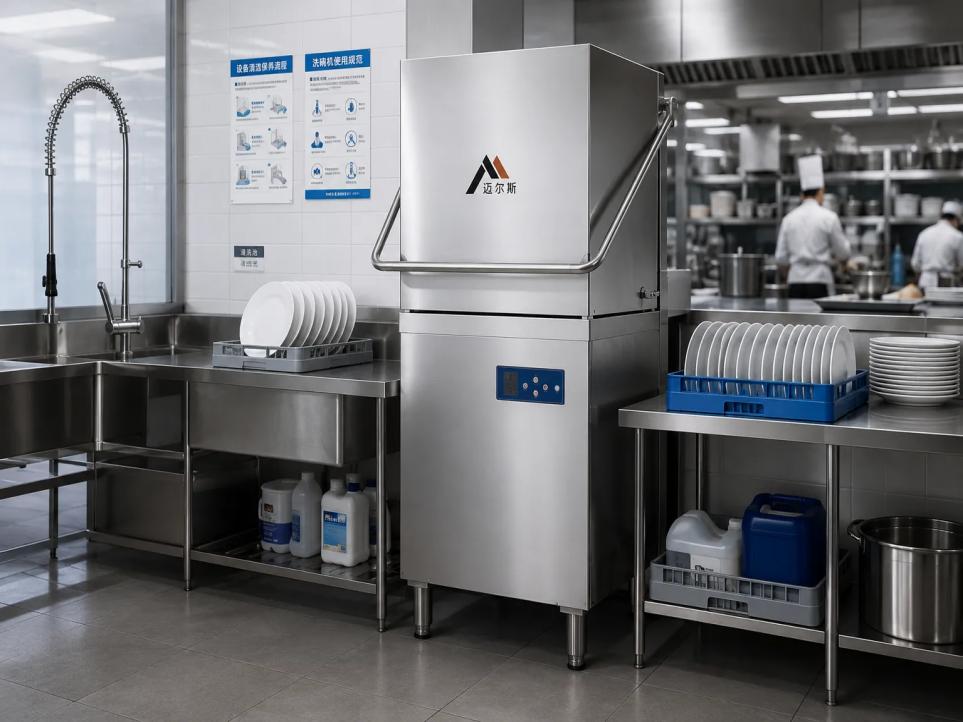
A hood type dishwasher is part of a complete warewashing system. The dirty-side table, pre-rinse area, dishwasher, clean-side table, racks, shelving, and staff movement all influence throughput.
For this reason, simply buying a higher-capacity machine does not necessarily solve a dishwashing bottleneck.
Worked Example: Sizing a Hood Dishwasher for Peak Service
Consider a busy commercial restaurant with:
180 meals during its busiest 30-minute period
Approximately 1.5 major washable items per meal
270 items returned during the peak
18 suitable items loaded per rack
The estimated rack requirement is:
270 ÷ 18 = 15 racks
Those 15 racks must be processed in approximately 30 minutes:
15 ÷ 0.5 hour = 30 racks/hour
Now allow a 20% operational margin:
30 × 1.20 = 36 racks/hour
A machine capable of approximately 40 racks/hour could theoretically meet this demand. However, if the restaurant experiences sudden dish returns, has heavy cookware, uses longer wash programs, or expects significant future growth, selecting a 60-rack/hour commercial hood type dishwasher may provide a more appropriate operating buffer.
This is why a 60-rack/hour machine is often a practical commercial specification even when the calculated average demand is lower.
When should you consider 60, 70 or 80 racks/hour?
A useful planning framework is:
40–60 racks/hour:
Suitable for many restaurants, cafés, institutional kitchens, and commercial kitchens with moderate peak dish volume.
60–70 racks/hour:
Appropriate for higher-volume restaurants, hotels, catering operations, and kitchens with concentrated service periods.
70–80+ racks/hour:
Worth considering for very high-volume operations, large catering facilities, banquet service, or applications where minimizing dish accumulation during peak periods is critical.
These are planning ranges rather than universal rules. Actual selection should be based on your rack configuration, ware mix, cycle requirements, labor availability, and site utilities.
What to Send a Supplier Before Choosing a Model
Instead of asking only, "How many racks per hour is your dishwasher?", provide the supplier with the operating information needed to size the machine correctly.
A useful specification request should include:
1. Peak meals per hour
Give the number of meals or covers served during your busiest period rather than your daily average.
2. Peak dish-return volume
Estimate plates, bowls, cups, glasses, cutlery, trays, and cookware separately where possible.
3. Rack configuration
Specify the rack dimensions and the typical number of items loaded into each rack.
4. Required wash programs
Tell the supplier whether the kitchen needs standard, intensive, high-temperature, or hygiene-oriented cycles.
5. Available labor
State how many employees will operate the warewashing station during peak service.
6. Water conditions
Provide:
Water treatment may be important where hard water can affect heating elements, wash performance, and maintenance.
7. Electrical supply
The available voltage, phase, frequency, and connected-load limitations should be confirmed before selecting the machine. Commercial hood-type models can have significantly different power requirements depending on heating configuration and inlet-water conditions.
8. Kitchen layout
Provide the available space and indicate whether the dishwasher will operate in a straight-through or corner configuration.
Also consider:
A well-designed workflow can improve practical throughput just as much as increasing the dishwasher's nominal rack capacity.
How Many Racks per Hour Does a Commercial Hood Type Dishwasher Need?
There is no single capacity that is correct for every commercial kitchen.
For many operations, 60 racks/hour is a strong baseline, but the correct specification should be determined from peak rack demand rather than the machine's marketing number.
If your calculated requirement is 35 racks/hour, a 40-rack/hour machine may technically meet the demand but leave little room for peak fluctuations. If your operation consistently approaches 50 racks/hour, a 60-rack/hour model provides a more useful buffer. If your kitchen has concentrated banquet service or very high dish turnover, moving toward 70–80 racks/hour may be justified.
The key is to match machine capacity, rack loading, cycle time, operator workflow, and peak dish returns as one system.
Conclusion
Choosing a hood type dishwasher based only on its maximum racks-per-hour rating can lead to either undercapacity or unnecessary investment.
The better approach is to calculate your busiest dish-return period, convert actual ware into rack loads, account for operator and loading time, and then select a machine with sufficient reserve capacity.
For many commercial kitchens, a 60-rack/hour machine offers a practical balance between throughput and operating capacity. Higher-volume operations may benefit from 70–80 racks/hour, particularly when dish returns are concentrated into short service periods.
Before purchasing a commercial hood type dishwasher, discuss your actual peak workload, rack configuration, wash-cycle requirements, utilities, and kitchen workflow with the equipment supplier. The right machine is not simply the one with the highest rated capacity—it is the one that can reliably keep your clean and dirty ware flows balanced during your busiest service.
FAQs
Is 60 racks per hour enough for a commercial kitchen?
For many commercial kitchens, yes. It is a common capacity range, but the correct choice depends on peak dish returns and rack loading.
Does a shorter dishwasher cycle mean higher capacity?
Generally, yes. A shorter cycle allows more racks to be processed per hour, provided loading, unloading, heating, and operating conditions do not become bottlenecks.
What is the difference between rated and actual capacity?
Rated capacity is normally based on specified cycle and operating conditions. Actual capacity can be lower because of loading time, pre-rinsing, longer programs, staff workflow, and water or heating conditions.
How much capacity should I keep in reserve?
A planning margin of around 15–25% above calculated peak demand is a useful starting point, especially for kitchens with uneven dish returns.
Is a hood type dishwasher suitable for high-volume restaurants?
Yes. Commercial hood-type machines are designed for professional warewashing and can provide substantial rack throughput while allowing dirty and clean workflows to be separated.
What information should I give a dishwasher supplier?
Provide peak meals, dish quantities, rack configuration, required cycle types, staffing, water conditions, electrical supply, available space, and kitchen layout. These details allow the supplier to recommend the appropriate commercial machine.
 English
 Español
 русский