The global hospitality and foodservice industry is currently navigating a perfect storm of operational challenges. Between chronic labor shortages, rapidly rising minimum wages, consistently high employee turnover rates, and general operational inefficiencies, restaurant owners and kitchen managers are feeling the squeeze on their profit margins more tightly than ever before.If you step into the back-of-house of any bustling restaurant, you will quickly identify one of the most labor-intensive and bottleneck-prone areas: the dishwashing station. When relying on manual hand-washing, the process is notoriously slow. It monopolizes human resources, often leads to inconsistent hygiene standards, and is incredibly prone to causing massive operational bottlenecks during peak dining hours. A backed-up dishroom means delayed plating, frustrated chefs, and ultimately, unhappy customers waiting for clean tableware.Because of these mounting pressures, the commercial dishwasher has undergone a dramatic evolution. It has graduated from being viewed simply as a heavy-duty "cleaning equipment" to serving as a comprehensive labor-saving system, a dynamic workflow automation tool, and a strategic cost-control solution.In modern foodservice operations, commercial dishwashers are no longer just cleaning machines — they are productivity tools that directly impact labor costs and operational efficiency.
Why Labor Costs Are a Major Challenge for Restaurants and Commercial Kitchens
Running a commercial kitchen has never been for the faint of heart, but today's economic climate has made it uniquely difficult. Minimum wage increases across various regions mean that every hour of labor carries a heavier financial weight. Coupled with sweeping staff shortages in the hospitality sector, managers are frequently forced to pay premium overtime costs just to keep their doors open.Furthermore, hiring and retaining back-of-house workers—particularly for the dishroom—has become an immense hurdle. The dish pit is a wet, hot, and physically demanding environment, leading to incredibly high turnover rates among dish staff. When a dishwasher quits mid-shift or doesn't show up, the entire kitchen grinds to a halt, forcing prep cooks or even head chefs to roll up their sleeves and plunge their hands into the sink.Industry statistics paint a clear picture of this challenge:
Labor often accounts for a staggering 25%–35% of total restaurant operating costs.
Dishwashing remains one of the highest-turnover kitchen positions, forcing management into a constant, expensive cycle of recruiting, hiring, and training.
How Commercial Dishwashers Reduce Labor Costs
Understanding why we need to cut labor costs is only half the battle. The real breakthrough comes from understanding how modern automated warewashing technology actively slashes payroll expenses. Let's break down the mechanics of how commercial dishwashers serve as the ultimate labor-saving investment, especially when integrated into warewashing systems.
1. Faster Washing Cycles Reduce Staffing Requirements
In the fast-paced environment of a food service operation, speed is currency. The sheer velocity at which a commercial dishwasher processes soiled wares drastically reduces the number of hands needed in the dishroom.When an employee washes dishes manually, they must individually scrub, rinse, and sanitize every plate and glass. Even the fastest worker typically requires 2 to 3 minutes to process the equivalent of one standard dish rack. In stark contrast, a modern commercial dishwasher obliterates this timeline, completing a full, sanitizing wash cycle in just 45 to 90 seconds per rack.Manual vs. Automated Washing Speed:
| Washing Method | Time Needed Per Rack |
| Manual Washing | 2–3 minutes |
| Commercial Dishwasher | 45–90 seconds |
Because of this rapid turnaround, a single high-capacity machine can effectively replace the labor output of multiple dishwashers. During peak hours, this speed guarantees a more stable workflow, leading to faster table turnover and higher overall kitchen productivity.To put this into perspective with "racks per hour" data:
2. Reduced Pre-Scrapping and Manual Cleaning
One of the most time-consuming aspects of traditional dishwashing isn't just the washing itself—it's the endless soaking, scrubbing, and pre-rinsing required before a plate even hits the soapy water.Modern commercial dishwashers are engineered with advanced technologies designed to tackle heavy food soils head-on. Features such as high-pressure wash arms, multi-stage filtration systems, automatic soil removal, and smart rinse systems work in tandem to blast away stubborn, baked-on food.Because the machine is doing the heavy lifting, employees no longer need to spend hours meticulously pre-soaking pots or manually scrubbing plates with a spray nozzle. This dramatically reduces repetitive, grueling labor and cuts down on the overtime hours previously required to clean up at the end of the night.
3. Automation Improves Workflow Efficiency
When you invest in a premium commercial dishwasher, you aren't just buying a machine; you are buying into an automated workflow ecosystem. High-volume environments benefit immensely from features like continuous rack feeding, conveyor automation, automatic temperature control, auto detergent dosing, and smart drying systems.These automated features remove the guesswork and the constant manual supervision from the dishwashing process. The machine self-regulates its water temperature to meet strict health codes, automatically injects the precise amount of cleaning chemicals, and uses heat recovery systems to dry dishes rapidly.By removing these manual touchpoints, kitchen managers can safely transition dishroom employees into more valuable, productive roles. The labor hours saved can be dynamically transferred to:
Food prep (chopping vegetables, portioning ingredients)
Customer service (running food, bussing tables faster)
Inventory management (organizing walk-in coolers, tracking stock)
Deep cleaning tasks (maintaining front-of-house hygiene standards)
4. Fewer Breakdowns and Less Maintenance Downtime
Downtime is a hidden labor cost that many operators fail to calculate. When a low-quality or residential-grade dishwasher breaks down in a commercial setting, the fallout is immediate. Staff delays skyrocket, emergency repair technicians must be called (often at premium emergency rates), and the kitchen is forced into a "manual fallback" mode where highly paid cooks are suddenly washing pots by hand.High-quality commercial dishwashers prevent this labor waste through robust engineering. Built with heavy-duty stainless steel construction, durable wash pumps, intelligent diagnostic control systems, and self-cleaning features, these machines are designed for the relentless punishment of a commercial kitchen.Investing in durability directly reduces unexpected labor waste and ensures uninterrupted operational continuity, keeping your staff focused on food, not broken equipment.
5. Lower Water and Energy Consumption Also Reduce Hidden Labor Costs
It's easy to look at a highly efficient dishwasher and only see the utility savings—lower water bills and reduced electricity usage. However, lower consumption also translates directly to reduced hidden labor costs.Traditional fill-and-dump machines or manual three-compartment sinks require constant attention. Staff must frequently stop what they are doing to drain dirty water, refill tanks, measure out new chemicals, and wait for water to heat up. An energy-efficient, recirculating commercial dishwasher requires less tank refilling, leading to fewer operational interruptions, simplified daily cleaning procedures, and shorter operating cycles.Manual Washing vs. Commercial Dishwasher Efficiency:
| Feature | Manual Washing | Commercial Dishwasher |
| Water usage | High (Continuous running water) | Low (Recirculating technology) |
| Labor intensity | High (Physical scrubbing) | Low (Load and go) |
| Sanitation consistency | Variable (Prone to human error) | Standardized (Guaranteed 180°F+ rinse) |
| Drying speed | Slow (Air drying takes hours) | Fast (Flash drying via high heat) |
Commercial Dishwashers Help Solve Restaurant Labor Shortages
The labor shortages plaguing the hospitality sector are no longer viewed as a temporary post-pandemic phase; industry experts agree they are becoming a long-term reality. As fewer individuals seek employment in physically demanding back-of-house roles, automation is shifting from a luxury to an absolute necessity.Dishwashing is notoriously difficult to recruit for. It is repetitive, messy, and tiring. The smart kitchens of tomorrow rely heavily on automation to bridge this gap.By integrating commercial dishwashers, operators can maintain a consistent, high-quality output regardless of staffing fluctuations. It drastically reduces the kitchen's dependency on maintaining a large, dedicated dishwashing team. Furthermore, modern machines feature intuitive digital interfaces that simplify training for new hires. By making the dish pit a more manageable, less grueling place to work, commercial dishwashers directly improve overall employee retention.
Choosing the Right Commercial Dishwasher for Your Business
To truly maximize your labor savings and optimize your kitchen's workflow, you must select the equipment that matches your specific operational volume and spatial constraints.
Undercounter Glasswashers for Bars and Cafés
Perfectly suited for coffee shops, bars, and bakeries, undercounter dishwashers and glasswashers are designed to fit seamlessly beneath standard counters.
Key Features: Compact footprint, incredibly fast cycle times (ideal for turning over coffee mugs and pint glasses), and low water usage. They allow bartenders and baristas to wash wares right at the point of service without leaving their station.
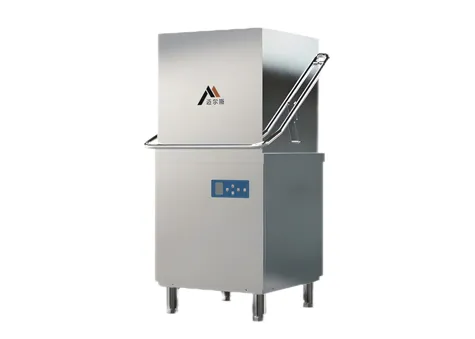
Hood Type Dishwashers for Restaurants
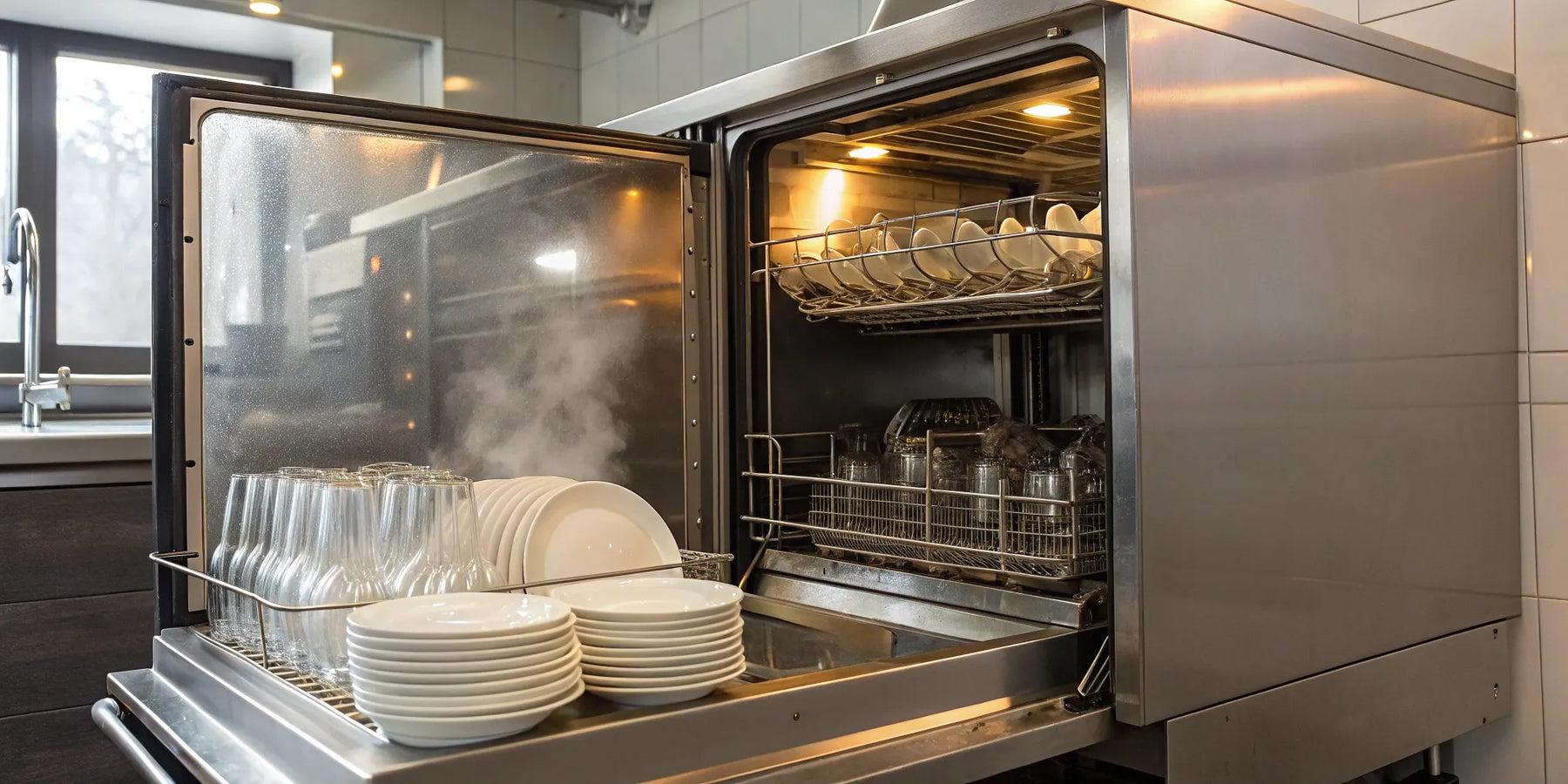
The workhorse of the traditional culinary world, hood type (or door type) dishwashers are ideal for medium-volume restaurants, hotels, and catering kitchens.
Key Features: High operational efficiency, ergonomic loading and unloading at waist height (saving workers' backs), and a labor-saving design that integrates beautifully with clean and soiled dish tables for a smooth linear or corner workflow.
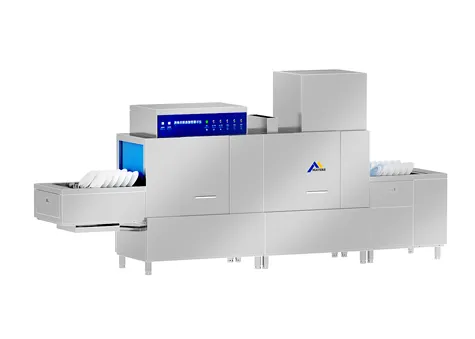
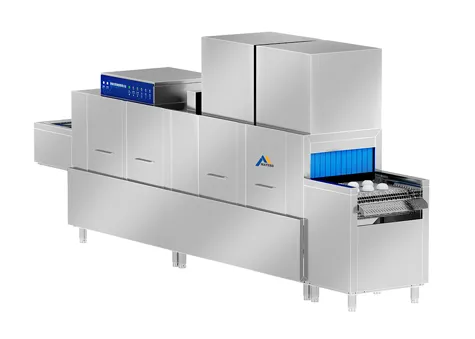
Conveyor and Flight Type Dishwashers for High-Volume Operations
When you are feeding the masses, you need industrial-scale automation. These massive systems are designed for central kitchens, hospitals, universities, and large food factories.
Key Features: Continuous washing capabilities, minimal manual handling, and maximum throughput. Wares are placed directly on a moving belt, moving through dedicated wash, rinse, and sanitizing zones, drastically cutting the labor required to process thousands of meals per hour.
How to Calculate the ROI of a Commercial Dishwasher
A high-quality commercial dishwasher is a capital expenditure, but it pays for itself astonishingly fast when you factor in the reduction of labor and utility costs. To understand the true value, operators must look at the Return on Investment (ROI).The ROI Formula:
ROI = Equipment Cost / (Annual Labor Savings + Utility Savings − Equipment Maintenance Cost)
When breaking down the math, you must consider the labor savings per shift (e.g., saving 4 hours of minimum wage labor daily), the drastic reduction in overtime pay, lower monthly water bills, and even the money saved from fewer broken dishes (since machines handle wares far more gently than rushed humans). Finally, improved operational speed means turning tables faster, directly increasing nightly revenue.Estimated Annual Savings Example (Based on a mid-sized restaurant):
| Factor | Estimated Annual Savings |
| Reduced labor hours | $12,000 |
| Water savings | $3,000 |
| Energy savings | $2,500 |
| Reduced breakage | $1,500 |
| Total Estimated Savings | $19,000 / Year |
Why More Foodservice Businesses Are Investing in Automated Warewashing Equipment
The foodservice industry is currently undergoing a massive technological renaissance. The push toward smart kitchens and comprehensive automation is driven by a desire to create more resilient business models.Beyond just labor, there is a massive global push for Sustainability (ESG). Modern dishwashers use a fraction of the water and energy of older models, helping brands meet their green initiatives. Furthermore, post-pandemic consumer expectations demand flawless hygiene compliance. Automated machines provide verifiable, digitally logged sanitation temperatures that guarantee food safety compliance.Through the lens of labor optimization and operational scalability, it is evident that commercial dishwashers have transcended their basic function. They are now becoming strategic infrastructure rather than optional kitchen equipment.
About Mayers Commercial Dishwashing Solutions
When upgrading your kitchen's infrastructure, partnering with a proven, globally recognized manufacturer is paramount. Mayers is a professional manufacturer specializing in commercial dishwashing equipment and intelligent catering solutions tailored for global foodservice businesses.Founded in 2012 and proudly based in Shenzhen, China—a global hub for advanced technology and manufacturing—Mayers focuses its expertise entirely on heavy-duty commercial dishwashers, commercial vegetable washing machines, kitchen support equipment, and fully customized warewashing solutions.With 13 years of dedicated manufacturing experience, Mayers operates out of a state-of-the-art 5000㎡ production facility. Every machine is built to the highest global standards, proudly holding ISO9001, ISO14001, and CE certifications. This unwavering commitment to quality has allowed Mayers to successfully export its automated cleaning solutions to over 150 countries worldwide.
Why Global Distributors and Foodservice Projects Choose Mayers
Mayers is not just a supplier; we are a strategic B2B manufacturing partner. Global distributors, restaurant chains, and foodservice project contractors consistently choose Mayers for our robust B2B capabilities:
One-stop OEM & ODM services: We bring your brand's vision to life with complete manufacturing support.
Customized design solutions: Tailored engineering to fit unique kitchen layouts and volume demands.
Private labeling support: Build your own brand equity using our reliable technology.
Adjustable voltage and configurations: Product size, voltage, and electrical configurations can all be fully customized to meet local market requirements anywhere in the world.
Compliance with global market standards: Engineered to pass rigorous international health and safety codes.
Professional installation guidance: Ensuring your equipment is set up for flawless operation from day one.
Full after-sales technical support: Our comprehensive after-sales support helps distributors and project contractors operate with absolute confidence, knowing they have factory-direct backing.
Explore Mayers Product Categories
Whether you are outfitting a boutique café or a massive central food processing facility, Mayers has the precise equipment to meet your needs:
Undercounter Glasswasher
Hood Type Dishwasher
Rack Conveyor Dishwasher
Flight Type Dishwashers
Commercial Fruit and Vegetable Washer
Commercial Ultrasonic Dishwasher
Plastic Crate Washer
Stainless Steel Work Table
Tray Return Conveyor
Customization Services
Frequently Asked Questions
How much labor can a commercial dishwasher save?
Depending on the size of the kitchen and the current workflow, implementing a commercial dishwasher can reduce dedicated dishwashing labor time by 20%–50%. This allows management to either reduce overall payroll hours or reallocate that staff to more productive, revenue-generating tasks like food prep or customer service.
Are commercial dishwashers more energy efficient than manual washing?
Yes, absolutely. Most modern commercial dishwashers use significantly less water, detergent, and electrical energy compared to continuous manual dishwashing processes. Advanced features like water recirculation and heat recovery make them highly sustainable and cost-effective over time.
Which commercial dishwasher is best for restaurants?
It heavily depends on your specific kitchen volume and available space:
Undercounter units are ideal for fast-paced cafés, bars, and small eateries.
Hood type (door type) units are the perfect middle-ground for standard to high-volume restaurants.
Conveyor or flight type machines are required for large-scale operations like cafeterias, hospitals, and busy banquet halls.
How long does a commercial dishwasher last?
When properly maintained, descaled regularly, and serviced according to the manufacturer's guidelines, high-quality commercial dishwashers can typically operate at peak efficiency for 8–15 years, providing an exceptional long-term return on investment.
 English
 Español
 русский